


Επιστροφή


 Foot and Ankle
Pain and deformities in the legs are a very common problem and together with low back pain they are the most common orthopedic symptoms. Most people will suffer from leg pain at least once in their lives.
Foot diseases can affect all ages in both sexes, from flat feet in children and Achilles tendon and ankle problems in athletes, to swollen toes, bruised toes or “bunches” and overlapping in older ages.
At the “OSTEON” Orthopedic Clinic, all diseases and deformities of the foot are treated by the head of the Department of Ankle and Foot Extremity, Dr. Panagiotis Symeonidis, one of the few Orthopedic Surgeons in Greece specializing in Foot Diseases.
The philosophy of Dr. Symeonidis is the personalized treatment for every problem in the patient’s legs, using the full range of conservative treatment and surgical techniques. The patient is fully informed about the issue of his leg, the treatment options and the rehabilitation in each case.
Everything at OSTEON


Our legs do a very hard job. They carry our weight for life, taking thousands of steps every day and over a million over the course of a year. There are also activities, such as jumping or climbing stairs, during which the weight that the legs lift, is a multiple of our weight in a state of immobility. If factors such as, long-term use of inappropriate shoes, excess weight, excessive activity and prolonged standing are taken into account in this strain, then there comes a time when the legs cease to withstand and problems arise.
The more inappropriate the shoes we wear, the greater the chances of developing a foot problem. An indicative example is women, for whom fashion imposes tight shoes with high heels. Prolonged use of heels either, causes or exacerbates foot deformities. Especially for women, high heels are jointly responsible for deformities, such as the blank toe, commonly known as “bunch”. That is why, as a condition it is more common in women than in men.
There are other examples, though. The athlete, who will exercise in shoes unsuitable for his type of sport or worn, will also have an issue with his feet, sooner or later. Similarly, in dance, and even more so in ballet, great attention is needed to the type of shoe and its proper fit, as for dancers the foot is the area with the most injuries.
We often see footwear advertised as orthopedic or anatomical, but this claim is not scientifically substantiated. There are a lot of supposedly orthopedic and anatomical shoes on the market, which people trust and not only do not solve the problem in their foot, but, on the contrary, often aggravate it.
Those who have foot discomfort should consult an orthopedist, specialized in foot diseases, about what kind of footwear they can wear. For example, there are shoes with high heels that are better made than some with lower heels. An orthopedist specializing in foot problems can give the right direction for the type of footwear one can buy, in order to have good health in their feet, without neglecting his external image.
In Greece, there is no framework for buying a foot scanner. Anyone can buy a foot scanner and make insoles.
The correct diagnosis of the problem of one leg is based on the correct clinical examination and imaging examination.
The foot scanner is at best an auxiliary means to make a diagnosis. Usually, we use it, especially the dynamic foot scanner, to construct orthopedic insoles.
However, not all patients need orthopedic insoles. Today, in Greece, there is a very large number of non-certified foot surgeons, which are handled by non-certified Personnel.
At “OSTEON”, we recommend a dynamic foot scanner, which operates on the basis of standards certified by international scientific organizations. The insoles we manufacture, are personalized, tailored to each patient’s foot, as the pair of insoles, in each person, is never the same.
However, special orthotic insoles are not recommended except for patients who actually need them. This is something that Dr. Symeonidis estimates, after measurements for the assessment of each patient’s gait.
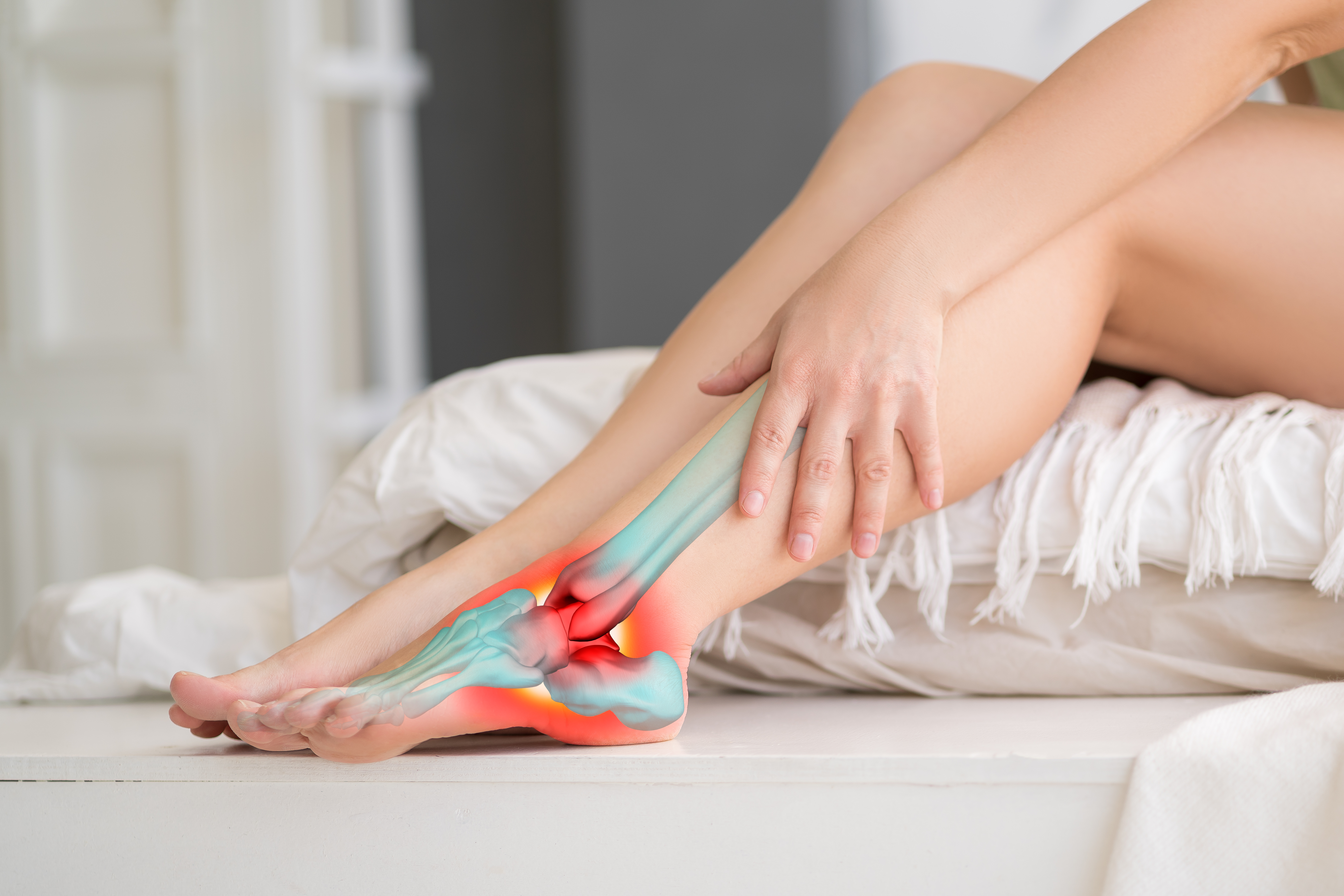
What are all these swellings in our legs, such as guts and calluses?
Swellings in the legs, such as “guts”, are nothing more than bones that have gone out of place. And this is also the reason why cutting off an inflation is wrong, because it will occur again. When we cut a “bunch”, we amputate one of our normal bones. The correct way to treat it is to restore the bones to their place, with operations called, corrective osteotomies.
Accordingly, calluses are also treated. The latter arise in places where a bone has left its place and then the skin reacts not to be pierced by the bone by creating holes, commonly known as “calluses”.
Therefore, removing calluses or cutting off any swelling in the leg is not a permanent solution. This is not a treatment but a treatment of a symptom. The treatment is about restoring the bones to their place.
How difficult is it to diagnose foot problems?
Pathology of the foot has a very wide spectrum and sometimes diagnosis is quite difficult. We often see patients who come to our clinic after three or even four visits to doctors without a clear diagnosis, having done a number of tests, such as MRI, X-ray, foot scan, without obtaining any result.
If the orthopedist does not have significant specialization and experience, if he does not know his domain very well, then there is a high probability that he will make a wrong diagnosis.
In any case, the correct diagnosis requires a careful and thorough clinical examination of the patient and his history.
How are foot diseases approached?
We always try to approach and treat conservatively whatever can be approached and treated conservatively. The conservative, moderate treatment has not received neither, the appropriate attention nor the appropriate depth of specialization. Surgically, we need to personalize the techniques based on the patient’s needs. It is a big mistake to have a technique or two and apply them to all patients. We need to know many surgical techniques and personalize the treatment on each leg.
There is a percentage of patients who believe that, the doctor will tell them that they need surgery. This, however, is a myth. In many of the foot problems, a very wide range of conservative treatment can be applied, which the foot specialist can recommend. The solution of surgery is the last resort and is chosen when there is no other alternative for the patient.
There is also another group of patients who are afraid of surgery, have heard or have personal experience from people around them, that foot surgeries fail and hurt. So, even though they would face their problem with an operation, they avoid going to the doctor who will simply tell them that, they need surgery immediately.
On the contrary, many people are seduced by advertisements for products that appear to be miracles for the foot, but buy them without any result.
The right choice is to trust the right doctors and solve one’s problem once and for all.
The legs are the support base of our entire body. If our support base goes wrong, in addition to the local problems that will manifest itself in the leg, such as pain, stiffness, swelling and deformity, this will also affect the rest of the body, causing problems in the knee, hip or back.
The truth is that, the foot can prove to be the Waterloo of the inexperienced surgeon. Today, many surgeries performed on the leg, fail, because they are performed on patients with the wrong diagnosis, the doctor chooses the wrong technique or does not have the right training and experience to perform it correctly.
A typical example is surgeries performed for aesthetic reasons. People who do not have a functional problem in their leg, end up in surgery, while there is a clear instruction in all official scientific organizations, internationally, in relation to the treatment of foot problems, that the leg should not be operated for aesthetic reason but only if there is pain or a functional problem.
Defintely not. With the technique of local anesthesia, a very good analgesic effect is achieved, not only during the surgery but also for a long time after it. The leg remains numb for 16-20 hours after surgery, relieving the patient of the need to take strong intravenous painkillers. The sensation gradually returns, and when this happens, the postoperative pain is then, minimized.
In foot surgeries we use materials that hold the bones together. As a result, the micromovements of the bones, which cause more pain, are avoided.
In addition, we use postoperative footwear, which is specially made to “embrace” the patient’s foot, in such a way, that it does not hurt after surgery.
Thus, the patient walks painlessly, from the next day.
The use of the term laser is persuasive and has been used aggressively and irresponsibly, misleading many patients to the wrong surgery. There is no laser in foot surgeries! On the other hand, we actually use the percutaneous technique sometimes, to correct some deformities. However, it is only one of the many methods that an Orthopedic Surgeon has at his disposal and its success is ensured only if it is applied to the right patients and if materials that will hold the bones together, are used during the operation.
Without the osteosynthesis that takes place when materials are used to hold the bones together, percutaneous surgery has very high rates of complications, which are then very difficult to treat.
The best and safest method is decided individually for the patient depending on his problem. The secret is that the surgeon is specialized and has extensive experience in a wide range of techniques, which he can use to achieve the optimal therapeutic result for each patient. Continuous training on new techniques and the adoption of the latest developments in medical technology is done to broaden the range of ways in which we can help our fellow human beings.
Implants help stabilize the bones after they are restored to their proper position, without allowing micromovements that cause more pain. Indicatively, in operations for the treatment of bruised finger or gampsodactyly, implants are placed, which allow the patient to get up and walk immediately, minimizing his postoperative pain and eliminating the risk of recurrence of deformities.
Also, most implants do not need to be removed. There are two major categories of implants: those made of titanium, which is one of the friendliest and most inert materials, and those that are bioabsorbable. Indicatively, we use special screws, the head of which is buried inside the bone and does not protrude.
As a result of this technological advancement, the removal of materials that was once a given second foot surgery is now only 1-2 out of 10 times. However, even when removal needs to be done, it is now performed under local anesthesia and not with a large surgery.
Finally, we usually avoid surgeries that let materials protrude out of the skin, such as needles that protrude like scaffolding, because they cause discomfort to the patient and increase the risk of infections.
In the vast majority of foot surgeries, regional anesthesia is performed, during which the area under the knee (popliteal block) or under the ankle (ankle block) is anesthetized. This provides sufficient anesthesia to perform the entire surgery without pain for the patient. If we want to put the patient to sleep, then this is done by sedation which is not performed by intubation, but by administering injectable, light drugs, similar to those administered during gastroscopy and colonoscopy.
In addition, numbness from regional anesthesia lasts 16-20 hours after surgery, allowing the patient to painlessly go through the critical period after surgery, where the pain is normally greater. Thus, the administration of heavy analgesics, injectable or orally is avoided. When the sensation in the leg does not return, the pain is then, quite manageable.
In this way, it is possible to perform operations with absolute safety on patients who, due to other health issues, are unable to perform general anesthesia with intubation.
The vast majority of patients stay in the hospital for one night, so that the next day we change the gauze and then go home. Extremely rarely, it may be necessary to stay in the clinic for a second day.
Many times we promise a quick or immediate return that does not respect healing and biological recovery time, resulting in failures, problems, complications. For each operation, the return time is individualized, and this must be clarified to the patient. We do not proceed with any operation without the patient being fully aware of the recovery plan.
There are several complications in foot surgeries, but they are only a few and the likelihood of their occurrence is significantly reduced, as long as the correct standards are met. At “OSTEON” we achieve this to the highest possible degree, operating in very clean rooms, at the Athens Euroclinic Hospital and never, in the doctor’s office. We use the best materials so that our patients’ bodies do not react and, we take our time in order to achieve the best possible result. We are not trying to impress by promising 10-minute interventions, at the expense of an increased risk of complications. Thus, we manage to have a very low percentage of complications in our surgeries.
One of the most common complications is stiffness, which we treat together with the patient and specialized physiotherapists.
Edema is also a very common complication after foot surgeries, even the most successful, and can last for a long time before it goes away.
On the contrary, recurrence of deformities is a complication that in the right hands will occur less than one in 10 cases. Most of the time, it happens when either, the wrong surgical technique is applied or a bad postoperative plan is followed, or the patient does not follow the plan that has been given to him.
Internationally, the recurrence rate of deformities after surgery is 10%. However, if the prescribed protocols and procedures are properly followed, the probability of recurrence of a foot deformity is significantly lower.
Finally, another complication is the delayed healing of the surgical wound. This can happen to smokers or patients with health problems that affect healing, such as diabetes, autoimmune diseases, etc. In these patient cases, at “OSTEON” we work with a team of doctors who focus on the patient in order to limit the risk factors, before the surgery, so that after the operation the healing has a smooth course.
As a rule, relapses should be prevented. They do not happen overnight and proper monitoring of the patient will prevent recurrence and avoid a new operation. One reason recurrences occur is that surgeons do not see patients after surgery.
We live in an era of specialization and in the problems of the foot there is a wide range of pathology and treatment, conservative, for which there is ignorance in the world, but also surgery, with many different techniques. Therefore, a large portion of patients who do not have a correct diagnosis, who suffer from a chronic problem without treatment or have a failed surgery, instead of going from one doctor to another, can find a definitive solution if they turn to an Orthopedic doctor (Orthopedist) specialized in foot problems.
No, they don’t exist. Specialization in foot problems is done only abroad and there are very few Orthopedists who have specialized abroad for more than 6 months, with clinical work and not in a laboratory.
Dr. Symeonidis has dedicated many years of clinical work to his training in foot problems, in international medical centers and next to the world’s leading surgeons of their kind, in the United Kingdom, Germany, USA and Australia.
If you are experiencing any pain or discomfort, please do not hesitate to contact us.