


Επιστροφή


 Spine
SpineScoliosis is a condition in which the spine shows a three-dimensional deformity. More specifically, there is a permanent lateral curvature of either, the entire spine or part of it, while at the same time it shows a rotation of the vertebrae involved.
Scoliosis usually occurs with great frequency in children during preadolescence, and is particularly noticeable during adolescence. Scoliosis causes the bones of the spine to be deformed so that, instead of a straight line in the middle of the back, the spine looks more like the letter “C” or “S”.
The most common form of scoliosis in children is often noticed around the ages of 10-12 years and occurs with a much higher frequency in girls than in boys.
Contrary to the common misconception, scoliosis in childhood is not caused by poor posture or the weight of the school backpack carried by children, but its manifestation is in most cases due to genetic/hereditary factors.
Everything at OSTEON


Scoliosis in children can occur at any age, from fetal life to puberty. In fact, this diversity in the age of onset can arise from various causes and lead to a variety of symptoms. Depending on the causes in children, we distinguish between idiopathic, congenital, neuromuscular and syndromic scoliosis. Correspondingly, depending on the age of onset, we have early-onset scoliosis and late-onset scoliosis.
Idiopathic scoliosis is perhaps the most common, but less identifiable form of scoliosis in children. Idiopathic generally means the exact cause of scoliosis is not known. It is speculated that a combination of causes, including genetic, environmental factors, contributes to the occurrence of idiopathic scoliosis. Idiopathic scoliosis occurs more often after the age of 8, but this does not mean that there are no cases of idiopathic scoliosis of early onset.
Congenital scoliosis usually occurs due to incomplete or improper development of the vertebrae and is usually present from fetal life. The condition is often noticed during prenatal check-ups. Congenital scoliosis can also be accompanied by problems in other parts of the body, such as the kidneys, heart and genitourinary system, which requires careful investigation.
Early-onset scoliosis occurs before the child reaches the age of 8 years. Depending on the age of onset, it is referred to as infantile scoliosis or juvenile scoliosis.
Neuromuscular scoliosis occurs in children who have problems with the muscles or nervous system. As nerves and muscles are vital for maintaining a stable and straight spine, some problem in these structures can compromise the proper development of the spine. Neuromuscular diseases such as spinal muscular atrophy, certain muscular dystrophies, syringomyelia, polio, and cerebral palsy often cause neuromuscular scoliosis.
Finally, scoliosis can occur in the context of a syndrome such as in children with Marfan syndrome.
The signs of scoliosis are usually noticed in prepubescent age. Symptoms may appear with different intensity depending on each child. Signs that indicate scoliosis in children usually include:
If scoliosis in children is not diagnosed early, it can have significant effects on both the child’s psychosynthesis and the health of the spine. Late diagnosis can result in significant extent of torso deformity, early spinal wear, back or back pain, or nerve pressure resulting in pain in the legs as well.
In advanced cases, obstacles are placed in the proper development and function of the lungs. Early diagnosis of the condition allows the application of therapeutic protocols that can bring about impressive improvement.
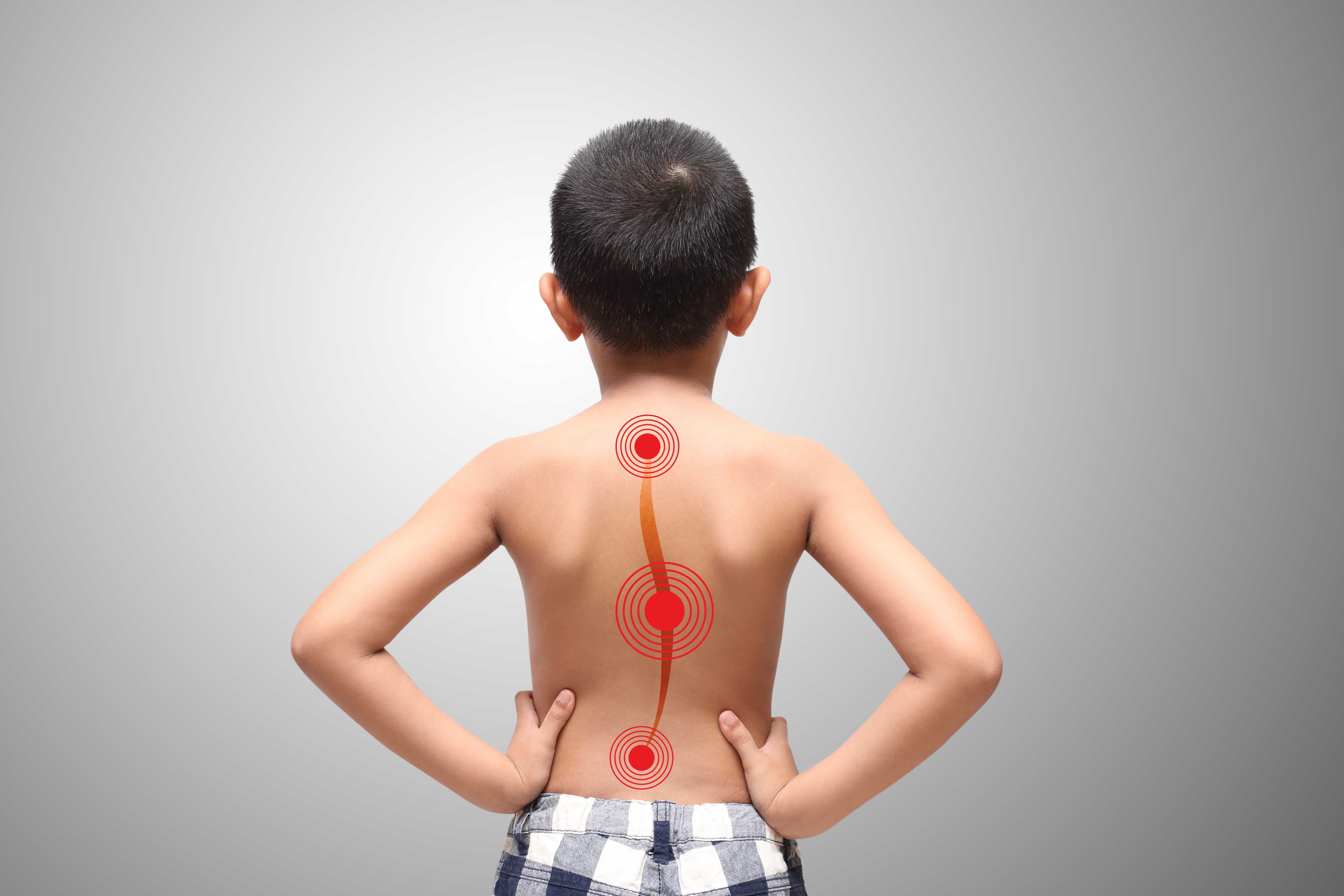
Diagnosing scoliosis in children involves taking a detailed medical history of the child, also taking into account family and personal history. In this way, the general health and the development phase of the body are determined.
This is followed by a clinical examination of the whole body and X-rays of the entire spine, in order to determine both the exact picture of the condition and the exact size (angle) of the scoliosis. In some cases, an MRI or CT scan may be indicated. A qualified orthopedic spine surgeon significantly assists in evaluating and determining the best treatment plan for the child.
After the diagnosis has been made, and the angle and severity of scoliosis has been determined, it is the turn of the therapeutic treatment. In the initial stages, regular monitoring is recommended every 9 months, in order to monitor the progression of the condition and to detect any deterioration in time. Children with scoliosis are also encouraged to participate in sports activities and perform core strengthening exercises.
In cases of mild or moderate curvature, it may be helpful to apply a brace for 16 to 23 hours a day, which contributes in helping the management or prevention of the progression of the condition, and improve the deformity.
The brace is removed to apply personal hygiene, to facilitate clothing or when the child performs sports activities. In case of infant or very young patients, a special plaster vest is applied instead of a guardian with the administration of general anesthesia, which is replaced every 3 months.
In advanced cases of scoliosis that do not show improvement with conservative treatment measures, surgical treatment is indicated. The appropriate surgical technique is selected based on the age of the child and the stage of development of the spine.
Before the operation, a thorough clinical examination is carried out and information is provided about the procedure and type of operation, as well as the postoperative course. In case of congenital scoliosis, the surgical techniques of semi-epiphysis and hemivertebral resection are applied.
If early-onset scoliosis is detected, the operation aims to control the progression of the deformity, so that it develops in the most normal way possible until skeletal maturation is completed. The operation involves the use of metal rods and implants, while more than one operation may be needed until the development of the spine is completed, at which point the spinal fusion operation can now be performed.
Posterior correction and spinal fusion is the most common surgery for the treatment of adolescent idiopathic scoliosis, which is performed using special materials such as screws and rods. Now, a new innovative technique for the surgical repair of adolescent idiopathic scoliosis has emerged, Dynamic Vertebral Body Tethering (VBT).
With this minimally invasive technique, no vertebrae fusion is required and this allows for the mobility and flexibility of the spine, progressively correcting scoliosis over time as the child develops. An experienced spine surgeon is able to recommend the appropriate treatment depending on the case, while at the same time creating a climate of trust and safety for the child.
If you are experiencing any pain or discomfort, please do not hesitate to contact us.